-
- Background
- Application scenario. Analysis of time-series data.
- Finite-response model.
- Infinite-response model.
.
- Require initial state:
for
.
produce
, which produces
and so on.
- Require initial state:
- Infinite-response model.
- NARX network:
- Definition: nonlinear autoregressive network with exogenous inputs. The output contains information about the entire past.
- General: several previous inputs and outputs.
- Complete: all previous inputs and output.
- Note: the memory of the past is completely stored in the output itself, not in the network.
- Alternative
- Goal: put the memory into the network.
- Method: introduce a memory unit to store information of the past.
- Memory unit:
.
- Hidden value:
.
- Output:
.
- Memory unit:
- Jordan network: maintain a running average of outputs in a memory unit
- Elman network: store hidden unit values for one time instant in a context unit
- Both network are partially recurrent because during learning current error does not actually propagate to the past.
- NARX network:
- State-space model.
.
is the state of the network
- Need to definite initial state
.
- This is a fully recurrent neural network. The state summarizes information about the entire past.
- Equations:
.
- State node activation function
is typically
.
- State node activation function
- Variants
- One to one: conventional MLP
- One to many: sequence generation. image caption
- Many to one: sequence based classification to prediction. speech recognition, text classification.
- Manny to Many, shifted: Delayed sequence to sequence. machine translation.
- Many to many, unshifted: stock problem, etc.
- Summary
- Time series must consider past inputs with current input.
- Looking into the infinite past requires recursion.
- NARX -> feeding back the output to the input.
- Simple recurrent networks maintain memory or context.
- State-space models retain information about the past through recurrent hidden states.
- Enable current error to update parameters in the past
- Backpropagation through time (BPTT)
- Forward
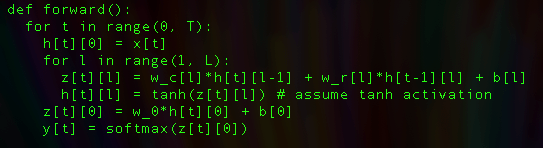
- Backprop
for all i for all T
- Simplified
.
- Simplified
.
- Backprop
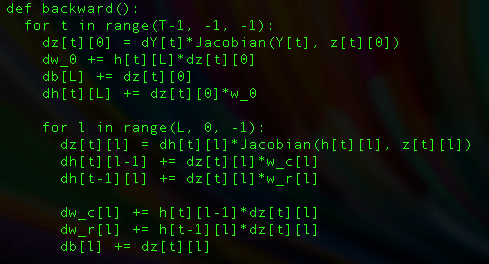
- Forward
- Bidirectional RNN (BRNN)
- RNN with both forward and backward recursion. Explictly model that the future can be predicted by the past and the past can be predicted by the future.
- Basic Structure: One hidden layer connecting forward; One hidden layer connecting backward. Each part work independently.
- Implementation: Implement the forward pass. Reuse the backward pass with flipping.
- Background


- Comment
- Reblog
-
Subscribe
Subscribed
Already have a WordPress.com account? Log in now.
 levendlee
Leave a comment